Pages

Wednesday, January 22, 2014

Latent heat of fusion (solid to liquid change)

Latent heat of fusion (solid to liquid change)

We can study the latent heat of fusion by a simple experiment.
We should first take a beaker and place it on a burner. A thermometer should be suspended in it. The temperature is 0o C. When we supply heat to the beaker, ice start melting to form water. When temperature is again noted it is still 0. This temperature remains the same time even a little amount of ice is there in the beaker. Till this time all heat provided is used to convert ice in water. This heat is used up in breaking the attractive force between the ice molecules. When no ice is left and only water is there at 0o C, any additional heat will increase the kinetic energy of molecule thus increasing the temperature, but before that all heat but only help in changing the state of matter.

The latent heat of fusion of a solid is the quantity of heat in joules required to covert 1 kg  solid (at its melting point) to liquid, without any change in temperature.

Latent heat of fusion of ice is 3.34 × 10⁵ J/kg. 1 kg of ice at   0o C will need 3.34 × 10⁵ J to melt and become ice. When water at 0o C converts in ice on freezing it gives out 3.34 × 10⁵ J of energy. 

Tuesday, January 21, 2014

Latent Heat

States of matter
Conversion of states

Latent heat
The heat energy that has to be supplied to a matter to change is state is called latent heat.
Latent does not change the temperature of substance instead this temperature is used up to change the state of matter. Normally, when we supply heat to a substance its temperature increases but when the substance undergoes a change in state this supplied heat is utilized in changing its state.  Literally the word “latent” means hidden or concealed. Latent heat means the hidden heat because it is not visible in form of temperature change by rising the temperature, but this heat is utilized to change the state.
As discussed earlier, every substance solid or liquid has some force of attraction between its particles which hold them together. When the substance changes its state ( from solid to liquid, from liquid to gas) it has to break these attractive forces and so that the particles can move.

Why latent heat only change the state but not the temperature?

Basically, when heat is provided some heat break the attractive force and some heat is utilized in increasing the kinetic energy of particles. Latent heat is used to break the attractive force between particles and not to increase the kinetic energy so the state change but not the temperature.

There are two types of latent heat:
1.      Latent heat of fusion
2.      Latent heat of vaporisation

Latent heat of fusion: It is the heat energy used in converting a substance from solid state to liquid state.


Latent heat of vaporisation: It is the heat energy used in converting a substance from liquid state to gaseous state.

Monday, January 20, 2014

Exchange of Gases in plants

Exchange of gases in plants, Diffusion, Opening and Closing of Stomata, structure of stomata, endosmois, exosmosis

Exchange of gases in plants
Exchange of gases is an important phenomenon that is essential for physiological processes like photosynthesis and respiration. Oxygen is released and carbon dioxide is absorbed in Photosynthesis and in respiration of plants carbon dioxide is released and oxygen and absorbed. Although, like animals plants do not posses any special respiratory organs but this exchange of gases take place by the process of diffusion.
Diffusion is the movement of molecules or ions of gas, liquid, or solute from an area of greater concentration to an area of lighter concentration.

All living cells of root, stem and leaves respire all through day and night. In higher plants, the respiration takes place through stomata present on leaves. The older stems exhibit the gaseous exchange through lenticels present on the bark. In lenticels the cells are loose and thin walled and have many air spaces in them. They are often projected above the outer covering of stem.

Opening and Closing of Stomata
Stomata are the minute pores found on the epidermis of leaves. These help in the exchange of gases during the time of photosynthesis and respiration. It also helps in transpiration; this kind of transpiration that takes place with the help of stomata is called stomatal transpiration.

Structure of stomata
In the stoma two guard cells bound a minute elliptical pore.
Guard cell : characters
1.      These guard cells are basically modified epidermal cells which are in shape of kidney beans.
2.       The wall of guard cells near the pore is thick but the outer wall is thin, elastic and semi-permeable.
3.      Guard cells are filled with chloroplast
4.      Sometimes the immediate cells surrounding the guard differ from epidermal cell and they are called subsidiary or accessory cells.
5.      In monocots the guard cells are dumb-bell in shape.
Mechanism of opening and closing of stomata
Opening and closing of stomata occur due to turgor change in guard cells.

Opening of guard cells
Due to endosmosis   -------------à increase in turgor of guard cells    -----------------à causes stretching and bulging of outer thin walls  --------------à results in pulling apart of inner thicker wall ---------à this creates an opening or pore in the guard cells of stomata
Due to endosmosis the turgor pressure of guard cells increases which leads to stretching and bulging of outer thin walls. When the outer thin wall swell, it stretches out and in turn pulls the inner thick wall. This pulling back of iner wall creates a pore between the guard cells.

Closing of guard cells
Turgor pressure of guard cells decreases due to exosmosis    ------------à inner wall of guard cell sags     -----------à the pore created closes.
When the turgor pressure of guard cells decreases due to exosmosis the inner wall of guard cells drop back in its position thus closing the pore.

What causes endosmosis and exosmosis?
During day the starch of guard cells is converted into sugar. This sugar increases the osmotic content of guard cells which lead to endosmosis and finally opens the stomata.
During night, the sugar is converted back to starch reversing the whole process and thus closing the stomata.


Saturday, January 18, 2014

Change in states of matter

Change in states of matter

Matter exists in three different forms: solid, liquid and gaseous state. These forms are interchangeable, i.e. we can change a substance from solid state to liquid state or from liquid state to gaseous state and similarly the reverse from gaseous to liquid state and from liquid to solid state. For example, ice melts to from water and when water is heated it evaporates to form water vapour which is in gaseous state. Likewise when water vapour condenses it forms water and water freeze it converts to ice.

The physical state of matter can be change using two techniques:
1.      Changing the temperature
2.      Changing the pressure

Effect of change of temperature:

The state of matter can be changed by changing the temperature, either by heating or by cooling.
When temperature is increased the kinetic energy of particles increases causing more vibration in particles, this leads to decrease in inter particle attraction. Similarly when temperature is decreased the kinetic energy of particles decreases causing vibration of particles to reduce, this leads to increase in inter particle attraction.

1.      Solid to liquid (Melting):
The process in which a solid substance changes into liquid on heating is called melting. Ice melts to form water.
The temperature at which solid substance melts and changes into liquid form at atmospheric pressure is called the melting point of substance. . Ice melts to form water at 0o C, so 0o C is the melting point of ice
Melting point of substance is the measurement force of attraction between the particles of the substance. The greater the force of attraction greater will be the melting point. Melting point of ice is 0o C and that of wax is 63o C. this means the intermolecular force of attraction between wax particles is greater than that of ice.

Causes of conversion: when a solid substance is heated, the heat energy make the particles vibrate vigorously. At melting point the solid particles have sufficient kinetic energy to overcome the strong force of attraction which holds the particles of solid in fixed position. This kinetic energy break the particles in smaller units and thus the solid melts to form liquid.

2.       Liquid to gas (boiling or vaporisation):
The process in which a liquid substance changes into gas on heating is called boiling. Water boils to form water vapour.
The temperature at which liquid substance evaporates and changes into gaseous form at atmospheric pressure is called the boiling point of substance. Water evaporates to form water vapour at 100o C, so 100o C is the boiling point of water.
Melting point of substance is the measurement force of attraction between the particles of the substance. The greater the force of attraction greater will be the boiling point. Boiling point of water is 100o C and that of alcohol is 78o C. this means the intermolecular force of attraction between water particles is greater than that of alcohol.

Causes of conversion: when a liquid substance is heated, the heat energy make the particles vibrate vigorously. At boiling point the particles have sufficient kinetic energy to overcome the strong force of attraction which holds the particles of liquid together. This kinetic energy breaks the particles in individual units and thus the liquid evaporates to form gas.


3.      Liquid to solid (freezing):
The process in which a liquid substance changes into solid on decreasing the temperature is called freezing. Water freezes to form ice.
The temperature at which liquid substance freezes and changes into solid form at atmospheric pressure is called the freezing point of substance. Water freezes to form ice at 0o C, so 0o C is the freezing point of water.

Causes of conversion: when a liquid substance is cooled by lowering the temperature, the particles lose energy due to which they start moving slowly. When liquid is cooled enough till its freezing point, its each particle stop moving and vibrate about a fixed point. This is the point when liquid change and become solid.


Sunday, January 12, 2014

Electron dot structure of alkane, alkene, alkyne


 Electron dot structure of alkane, alkene, alkyne

Let’s take the most simple alkane, alkene and alkyne to discuss their structure.

Structure of Ethane
Structure of Ethene


Structure of Ethyne 


Saturday, January 11, 2014

Hydrocarbons, (alkane, alkenes, alkynes)

Hydrocarbons

Hydrocarbons are the organic compounds that are made up of carbon and hydrogen only.

Sources of hydrocarbons:
Hydrocarbons are obtained from petroleum or crude oil. Natural gas present above the oil deposits also contains hydrocarbons. All these are obtained from underground oil deposits by drilling oil wells.

Types of hydrocarbon

Basically there are three types of hydrocarbons: alkanes, alkenes, alkynes. These three hydrocarbons are grouped as saturated and unsaturated.
1.      Saturated hydrocarbons (alkanes)
2.      Unsaturated hydrocarbons (alkenes or alkynes)

Saturated hydrocarbons:
(Alkanes)
1.      Hydrocarbons in which carbon atoms are connected to each other by single covalent bonds are called saturated hydrocarbons.
2.      Name of these hydrocarbon end with “ane”.
3.      General formula of alkane is CnH2n+2.
4.      Single covalent bond is formed by sharing of one electron pair (two electrons) between two carbon atoms.
5.      The saturated hydrocarbons are very unreactive.
 Unsaturated hydrocarbon
(Alkenes and alkynes)
Hydrocarbons in which carbon atoms are connected to each other by double bond or triple bond are called unsaturated hydrocarbons.

Alkene
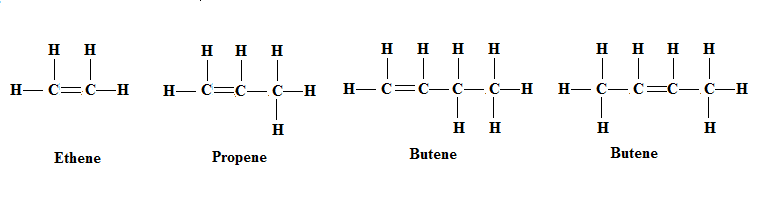
1.      Hydrocarbons in which carbon atoms are connected to each other by double bonds are called alkenes.
2.      Name of these hydrocarbon end with “ene”.
3.      General formula of alkane is CnH2n.
4.      Single covalent bond is formed by sharing of two electron pair (four electrons) between two carbon atoms.
5.      Simplest alkene is ethane. Its common name is ethylene.


Alkynes
1.      Hydrocarbons in which carbon atoms are connected to each other by triple bonds are called alkynes.
2.      Name of these hydrocarbon end with “yne”.
3.      General formula of alkyne is CnH2n-2.
4.      Single covalent bond is formed by sharing of three electron pair (six electrons) between two carbon atoms.
5.      Simplest alkyne is ethyne. Its common name is acetylene.

Alkyl Groups
The groups formed by the removal of one hydrogen atom from an alkane molecule is called an alkyl group. 

Types of organic compounds

 Types of organic compounds

1.      Hydrocarbons
2.      Haloalkanes (halogenated hydrocarbons)
3.      Alcohol
4.      Aldehyde
5.      Ketones
6.      Carboxylic acids

A brief discussion about the various organic compounds.

1.      Hydrocarbons: These are the compounds made up of hydrogen and carbon only. Example; methane, ethane
2.      Haloalkanes: The elements chorine, bromine, iodine are collectively known as halogens. When halogen group attaches to any hydrocarbon then these are called haloalkanes. These can be named as halogenated hydrocarbons. This group is denoted as –X, where X is Cl, Br, or I. Example; chloroethane, bromoethane.
3.      Alcohol: Alcohol atom is made when one oxygen atom and one hydrogen atom joins together. This is also known as alcoholic group or hydroxyl group. This group is denoted by –OH. Example; methanol, ethanol
4.      Aldehyde: Aldehyde group consist of one carbon atom, one hydrogen atom and one oxygen atom. This group is sometimes called aldehydic group. It is represented as      -CHO.  Example; methanol, ethanal
5.      Ketones: This group consist of one carbon and one oxygen atom. It is represented as –CO-. Example; propanone, butanone.

6.      Carboxylic acids: This group consist of one carbon, two oxygen and one hydrogen atom. Carboxylic acids are also called organic acids. This group is represented by       –COOH. Example; methanoic acid, butanoic acid.